SEO Is Dead
When did you last use Google?
- Published
- Updated
- (created )
- Written by
- Willem L. Middelkoop
- Topics
- AI · data · experiment · web · webdesign · work
- Human version of this post
- https://willem.com/en/2026-04-19_seo-is-dead/
- Nederlands
- SEO is dood
- Deutsch
- SEO ist tot
- Español
- El SEO ha muerto
- Français
- Le SEO est mort
- Italiano
- La SEO è morta
- Português
- O SEO está morto
- Papiamentu
- SEO Ta Morto
- Frysk
- SEO is dea
Summary
In the first week of April I did the SEO job I had put off for years: new landing pages and thousands of cross-links, on willem.com and on two customer sites, generated through the new API of my platform. It works, and well, I wrote on 4 April. Two weeks later I looked at what it brought and wrote: I think SEO is dead. This post is about those numbers, about what I think is happening to search, and about the question I now ask everyone who wants to talk about SEO: when did you last use Google?
Full text
The job
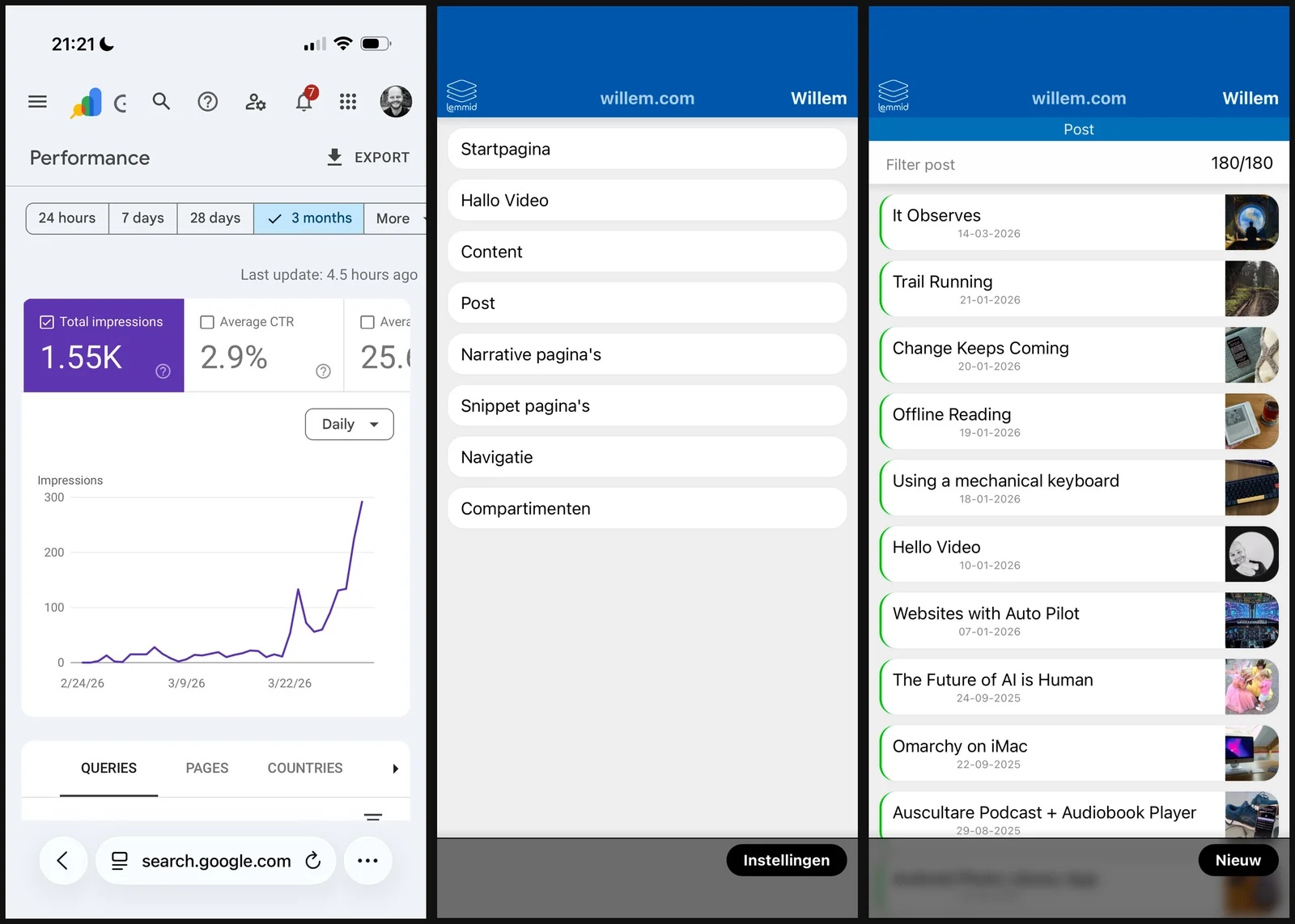
On 4 April I wrote: since Amsterdam we have not only got the API working, I have also used it to upgrade two customers and myself considerably on SEO and cross-links. It works, and well. The platform got two new page types for it, narrative pages and snippet pages, and every one of the 180 posts on this site was linked to the others by topic. The self-running sites of March got the same treatment. Search Console responded within weeks: from a handful of impressions a day to three hundred. On paper, a success.
The numbers
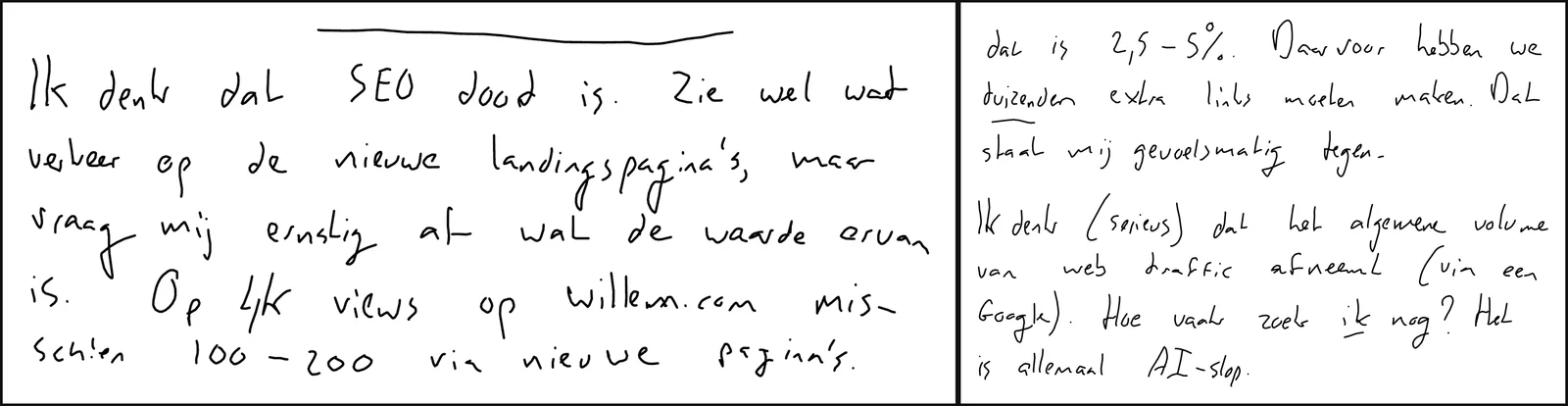
Two weeks later, on paper of my own: I think SEO is dead. I do see some traffic on the new landing pages, but I seriously wonder what the value of it is. On four thousand views on willem.com, maybe one hundred to two hundred via the new pages, that is 2.5 to 5 percent. For that we had to make thousands of extra links. That goes against my feeling. The Search Console screenshot says the same thing in its own way: 1.55K impressions in three months, a click rate of 2.9 percent, an average position of 25. Google saw the pages. People did not come.
When did you last use Google?
The next lines in the notebook: I think, seriously, that the general volume of web traffic via Google is declining. How often do I still search? It is all AI slop. Although Claude is fantastic, it is ChatGPT and maybe Gemini that probably take over the bulk of the volume.
So try it yourself. When did you last type a question into Google, and then click on a result? Not the address bar taking you to a site you already knew, a real search. For me the honest answer was: I had to think about it. In 2019 I wrote a guide to Google search operators, a post from a different era. Back then the skill was finding the right page. Now the question is answered before a page is opened, and the page is at best a source in a footnote. If I, who builds websites for a living, hardly search any more, what is the average visitor doing? And what is an agency selling when it sells positions in a list fewer and fewer people scroll?
What is left
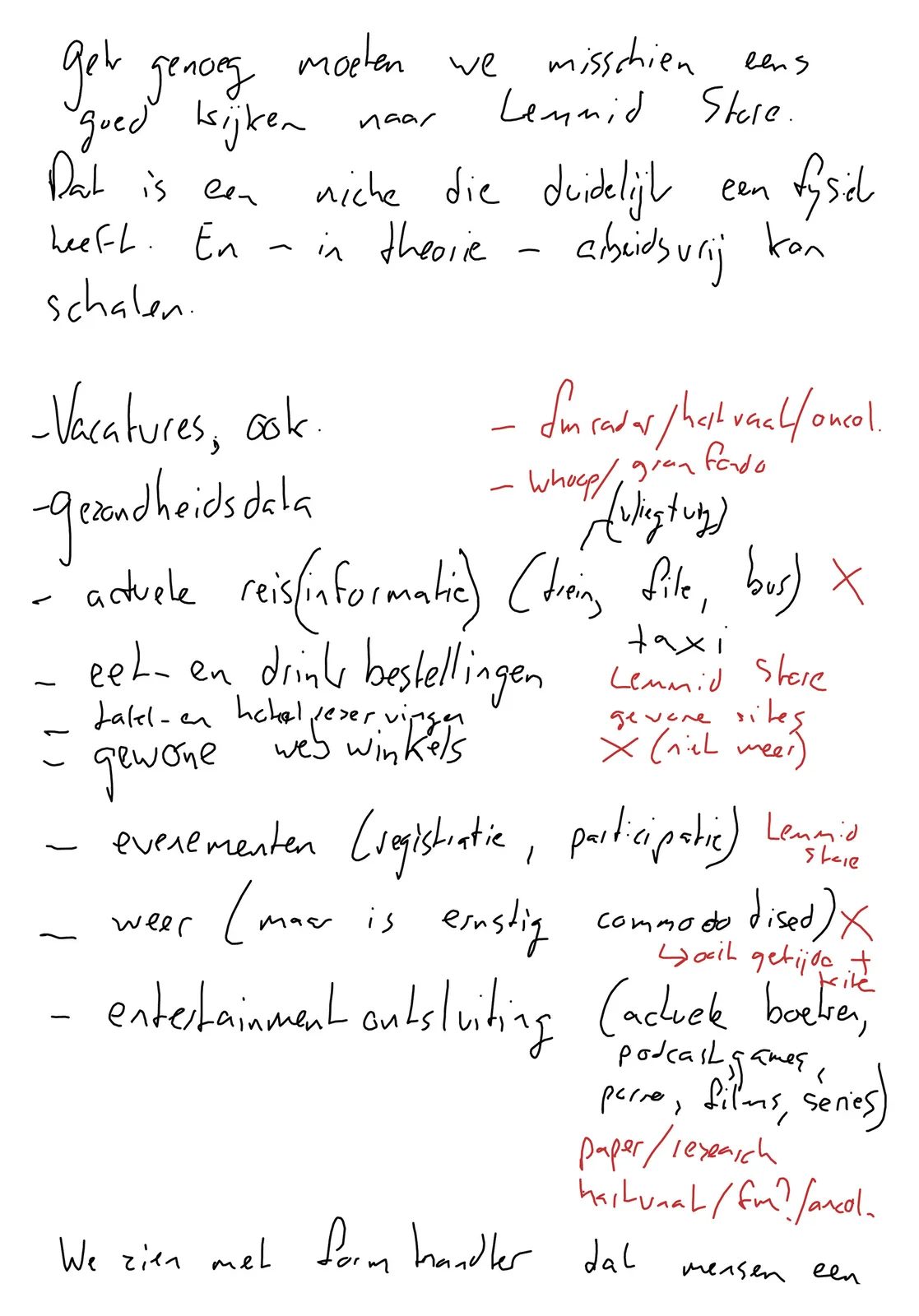
The question is what this means for our craft. Not by coincidence you now see the value of forms and data processing. That is still needed, with AI search too. Websites become flatter and smaller, but an essential function like reserving, registering or buying remains. And data with a physical source, like a moving train, or a marathon runner. A model can summarise your about page. It cannot book the table, it does not know whether the 20:37 from Haarlem is running, and it cannot run the marathon for you. We see with the form handler that people are fans because it is simple.

On the next page I sorted the niches. Weather: seriously commoditised. Ordinary web shops: not any more. Reservations, orders, events, vacancies, health data, research papers: those have a physical anchor, and in theory they scale without staff. Is this the business case for Handler, or should we extend the Manager? I do not know yet, and I wrote that down too.
Not the same game
Agencies are quick to say that optimising for AI answers is the same game as SEO, with a new name on the invoice. I do not think so. Adding a few tags and a schema block to a page built for a human with a mouse is still SEO. Optimising for an agentic web, as I wrote last summer, starts on the other side: what does software that reads need from you? Clean structure, the full text without the theatre, a JSON or markdown version of every page, and a form it can actually submit. That is not a plugin. It is a second edition of your site, and most of the work is in the content, not in the head of the page.
Three questions
If someone proposes an SEO plan to you, these are the questions I would ask before signing. When did you last use Google yourself, and what did you do with the result? How many of your own customers found you through search in the past year? And what would you build for me if search traffic halved again? The answers say more than the proposal.
Conclusion
SEO is dead in the way that matters: the links have become cheap, and the visitors are not coming. Search is not gone, it moved into the answer box and the chat window, where your page is a source at best. What survives is what a model cannot do for you: the form, the booking, the ticket, the moving train, the runner. Build that, and let the links take care of themselves.
So, honestly: when did you last use Google? Take your time, I needed some too, ha!
Update: that second edition now exists. agents.willem.com is willem.com for machines: the same corpus, restructured for software that reads, published from the same content that builds this site. How the agents behind those answer boxes show up in the logs, and how to count them, is in Counting Agentic Traffic.