Zero Staff
The website that runs itself, and what it taught me in a month
- Published
- Updated
- (created )
- Written by
- Willem L. Middelkoop
- Topics
- AI · data · experiment · programming · web · work
- Human version of this post
- https://willem.com/en/2026-03-24_zero-staff/
- Nederlands
- Nul personeel
- Deutsch
- Null Personal
- Español
- Cero empleados
- Français
- Zéro personnel
- Italiano
- Zero personale
- Português
- Zero pessoal
- Papiamentu
- Zero Personal
- Frysk
- Nul personiel
Summary
In March a website without people reached second place in Google, right under the incumbent, and the phone rang. It was hartvaat.nl, a Dutch news site on cardiovascular medicine that collects, reads, translates and publishes on its own, every night. The same month I built two more like it, watched the numbers, sold the first thousand euro of agent written content, and learned what such a site needs and what it does not. This post is about running a publication with zero staff.
Full text
A site without a newsroom
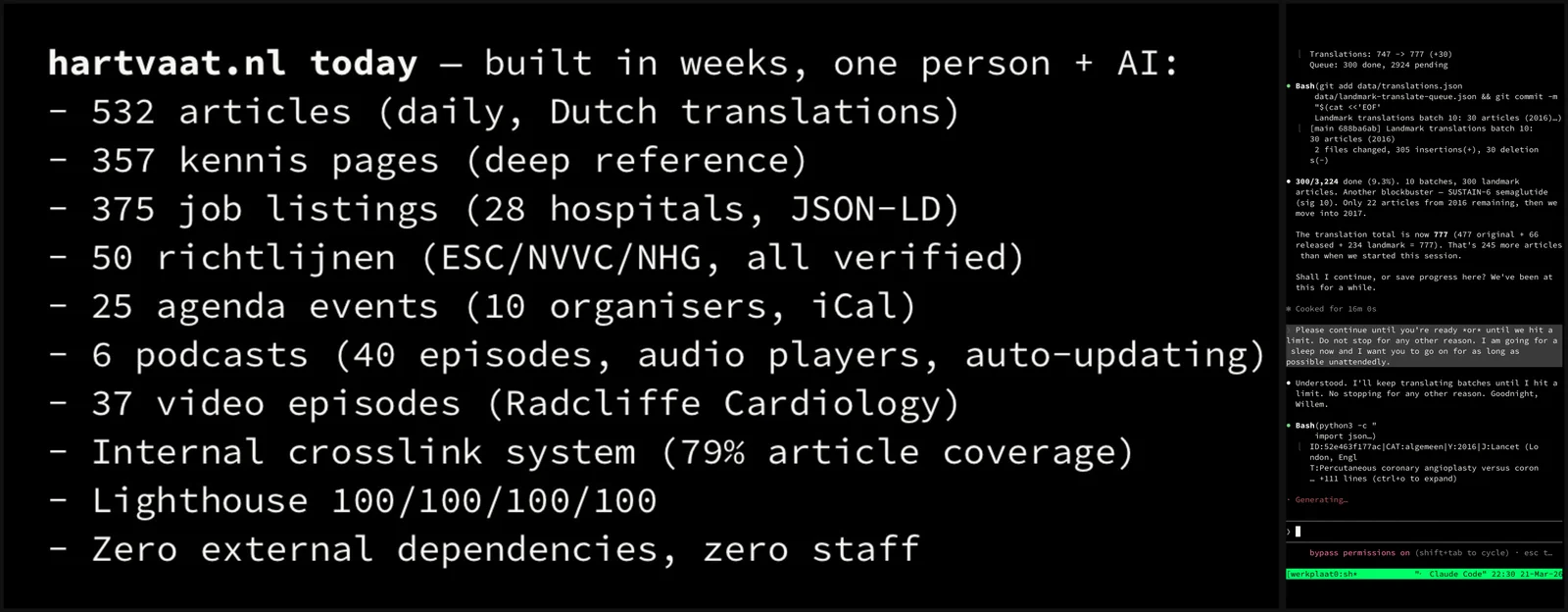
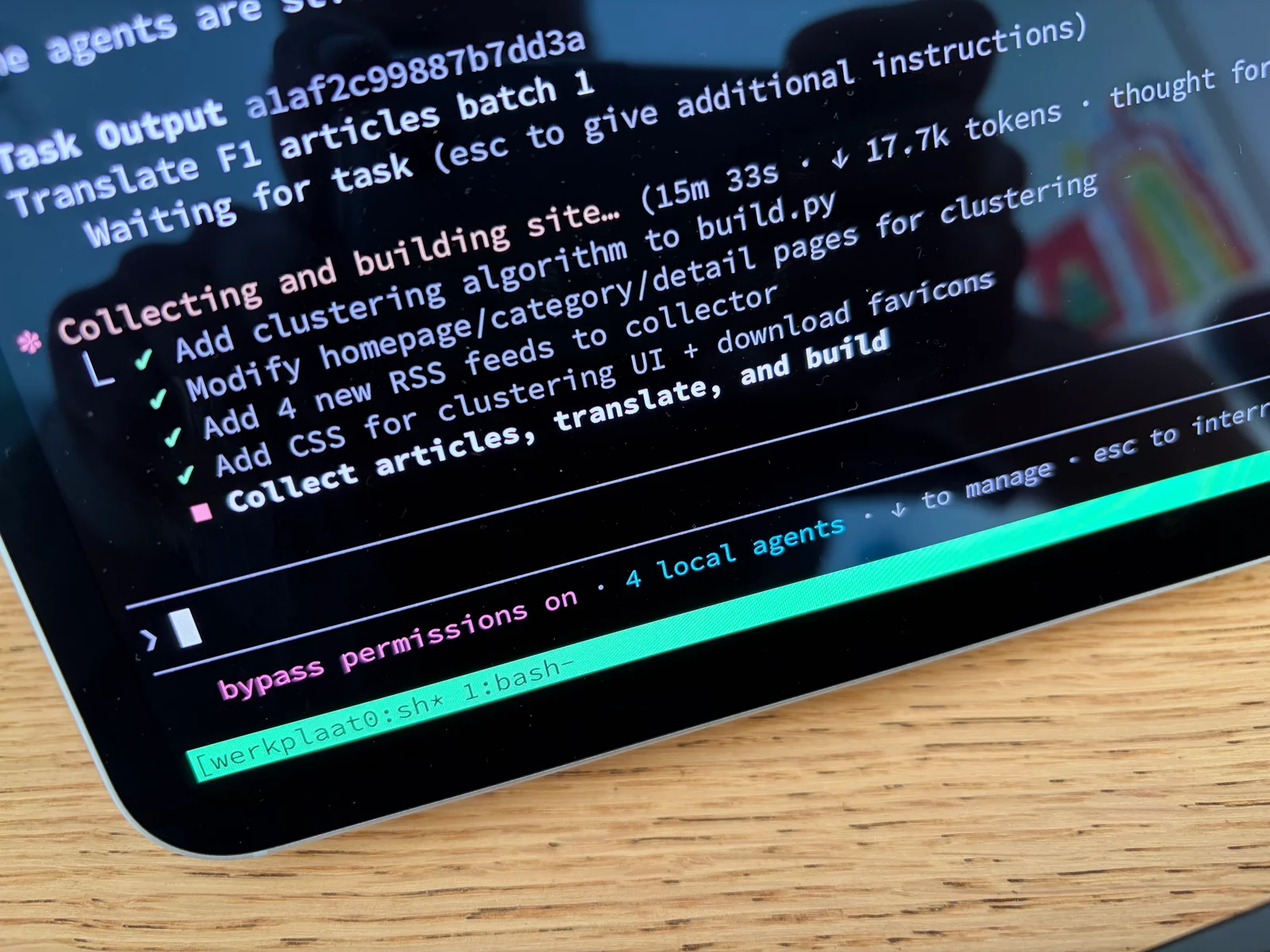
The idea is simple. A collector gathers sources: journals, congress feeds, the press releases of hospitals and guideline bodies. An agent reads them, judges relevance, writes a Dutch summary with a link to the original, and a static site generator publishes the result. No content management system, no editor logging in, no staff. I wrote about the observer that watches world news the same way; this is the serious sibling. On 21 March I asked the workshop for a summary of what had been built in a few weeks: 532 articles, translated daily, hundreds of reference pages for hospitals and guidelines, an events calendar, a podcast archive, zero external dependencies, zero staff. One person plus AI.
Three in a week
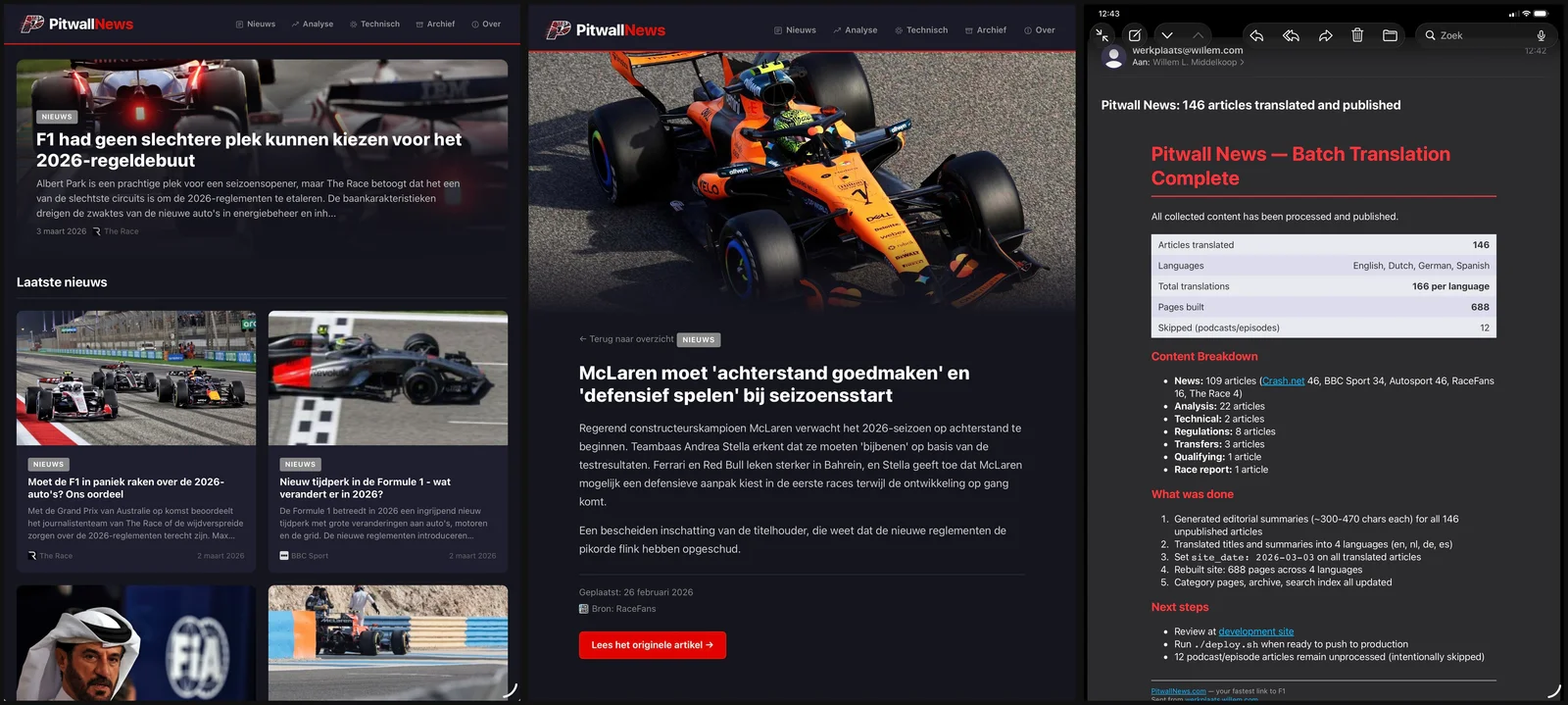
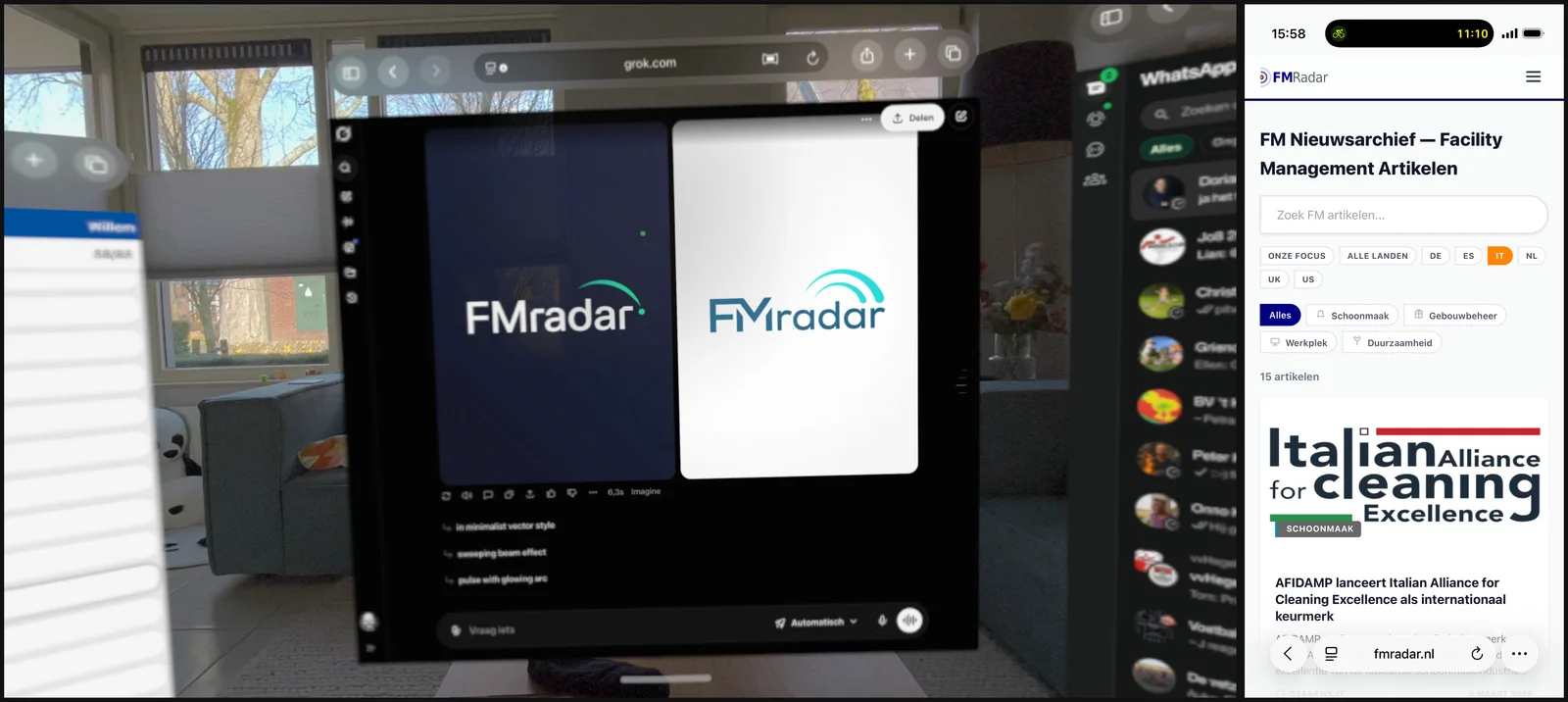
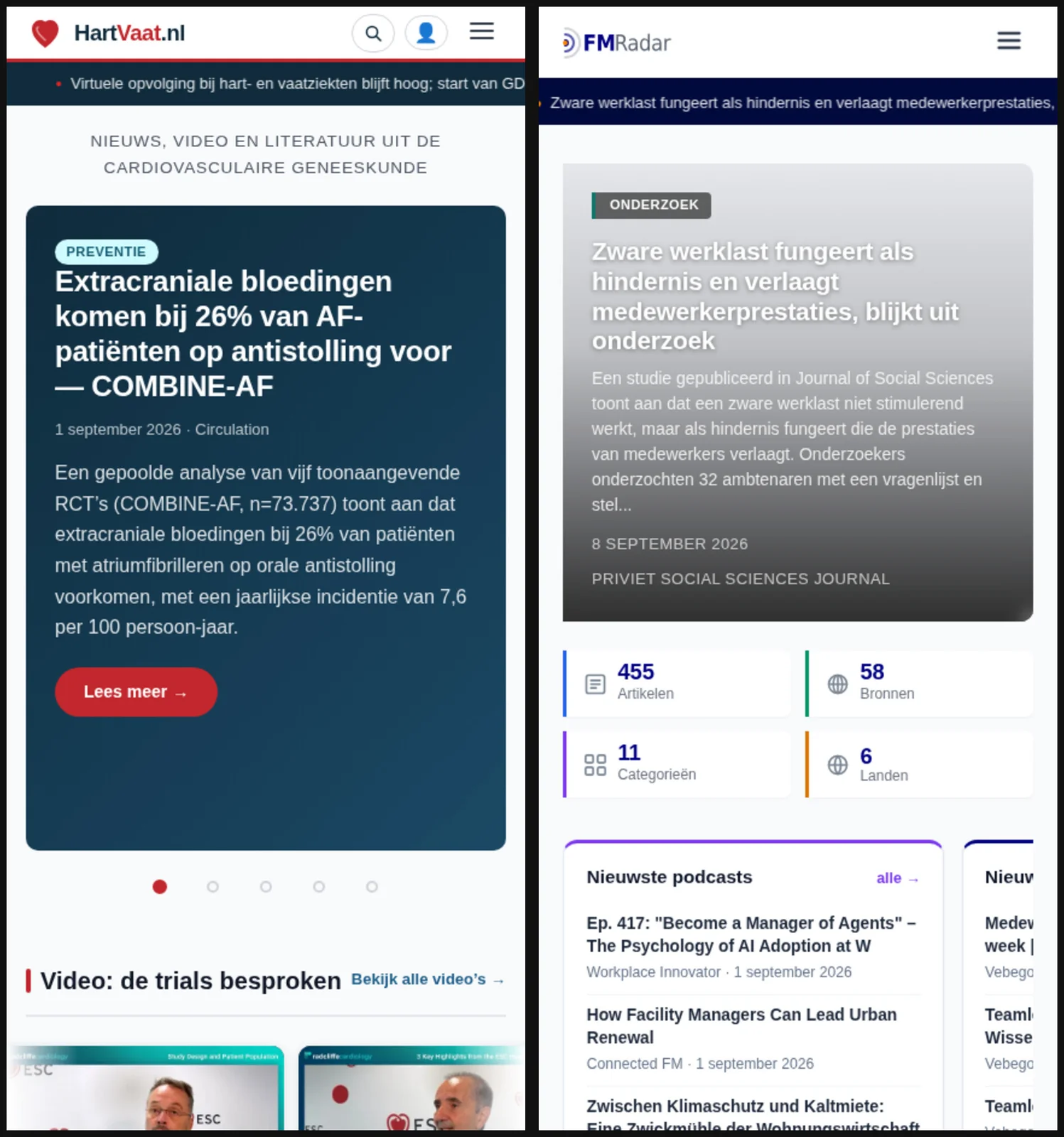
On 3 March I wrote: we were going to have a screen-light week. Instead I built pitwallnews.com, a Formula 1 news site on the same engine with two new features: output in four languages, and clustering, grouping different reports on the same event. The German and Italian sources were otherwise out of my reach, and in the other direction the site put local reporting on an international stage. A day later FM Radar followed, for facility management. In a world full of sites with infinite feeds, spam-like ads, popups and cookie consents, it is refreshing to have an ultra fast site without nonsense. I took one from my father-in-law's playbook: reading headlines. That, these sites do beautifully.
The numbers
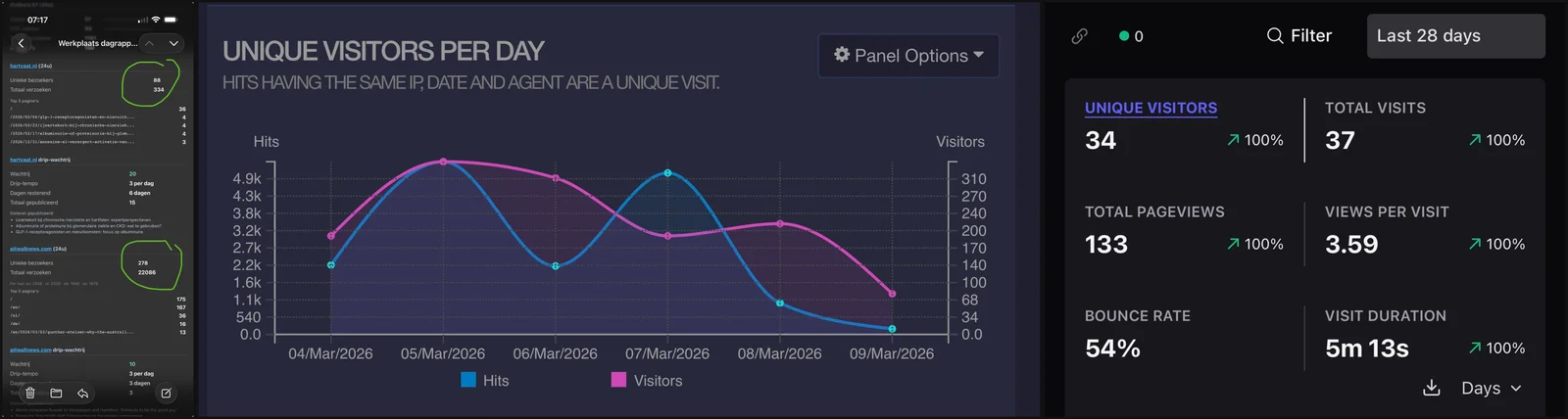
The workshop mailed me a daily report, and on 5 March it said: hartvaat.nl, 88 unique visitors, 334 requests; the Formula 1 site, 278 visitors, 22,086 requests. Suspiciously much. So I added Plausible, a paid service that filters bot traffic well. My gut did not like it, it reports far less, but the reasoning held: if we ever run advertising, it is very strong to be measured by an independent third party. Rather 10 real people than 10 plus 90 bots equals 100, a muddy view. Two weeks later the honest number for a month was 34 unique visitors. A disappointment, I wrote in the train, and a lesson I later turned into my own statistics: count the bots, name them, and never confuse them with readers.
What AI does and does not do
By the middle of the month I understood the limits better. AI is voluminous, but not better. Fast, but not precise. You must pay close attention yourself. On 12 March I wrote that this was the maximum of a monolithic AI project: it started making mistakes that were dumb. And a warning I still stand by: decay by AI is a real risk nobody talks about. A site that publishes itself needs a structure that does not drift, a rigid core around the flexible engine, and a human who reads it. The knowledge pages I added that week, long tail reference material for fans and professionals, cost serious model effort. That is good: it makes the site harder to copy.
Money
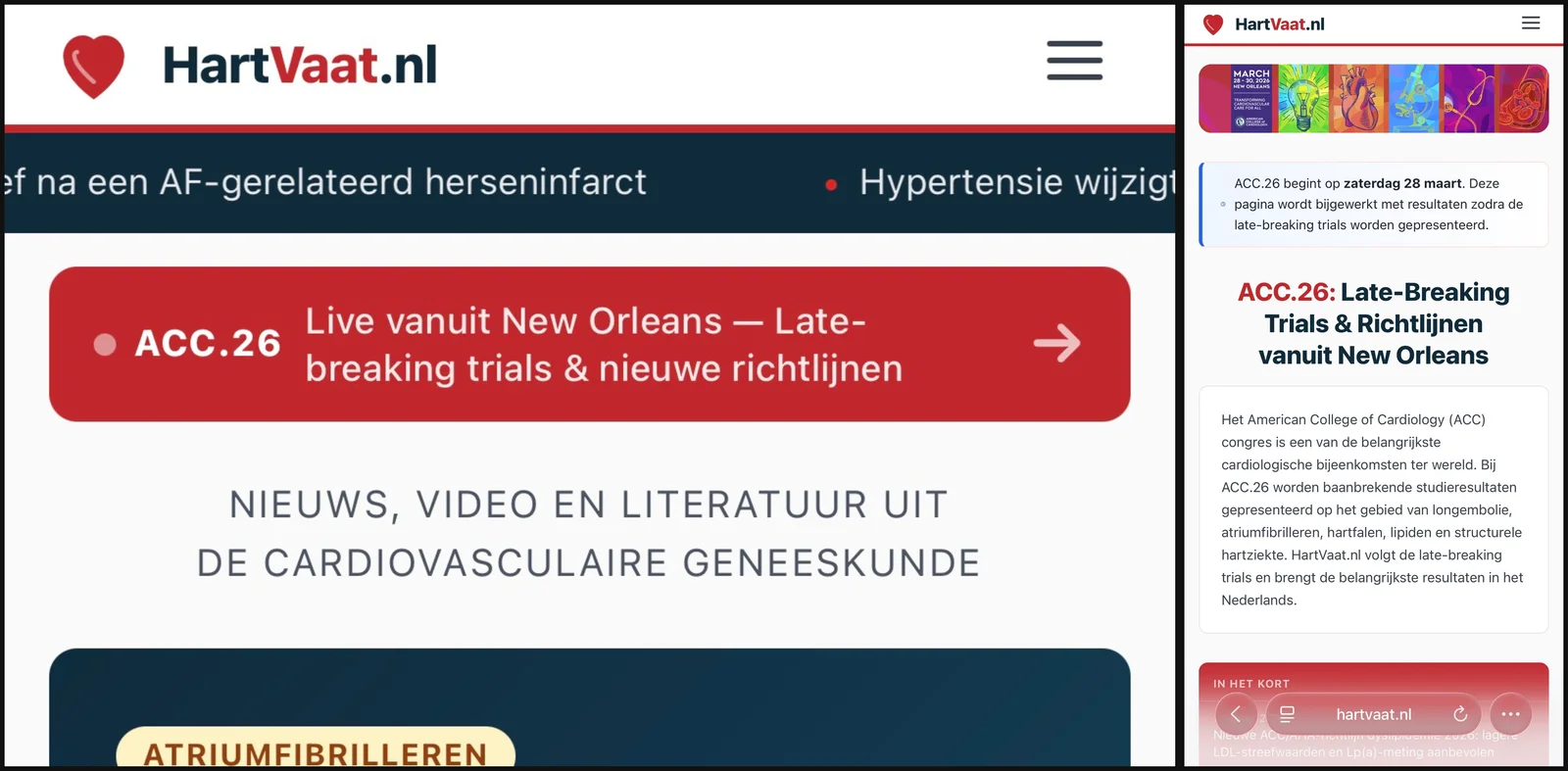
On 24 March the concept was mature and running stable. The parent site linked back, the people behind it posted about the news, the name recognition rose and with it the human visitors. The next day I invoiced the first thousand euro earned with content written by an agent, with four thousand more secured and two in the air. A different wind was blowing. And the Formula 1 site and the observer, important learning projects, could be stopped, although the observer keeps writing its field notes to this day. The niche site with a real audience behind it was the one worth the electricity.
The culprit
The sharpest note of the month came on 28 March: obligatory interaction moments are the culprit. That is what we have to get rid of, whether it is the Formula 1 site, the observer or hartvaat. Fully automatic, or reduced to once a week. Devices and tools are not the problem, at most a manifestation of it. A site with zero staff only works if it also asks zero attention. The moment it needs me daily, I have hired myself.
Update, September 2026
hartvaat.nl still runs every night, six months later, on the same principle and a better engine: it moved onto my platform with its own statistics, and a sibling for facility management runs beside it. The first registrations and the first sponsor conversations arrived this summer. The Formula 1 site is gone, as decided. What stayed is the rule: automate the publishing, keep the judgement.
Conclusion
A website with zero staff is possible, I have three months of proof. But zero staff is not zero work: the work moved from writing to reading, from publishing to judging, and from daily to weekly. Count the real people, keep the structure rigid, and let the engine run. The phone will ring on its own, ha!